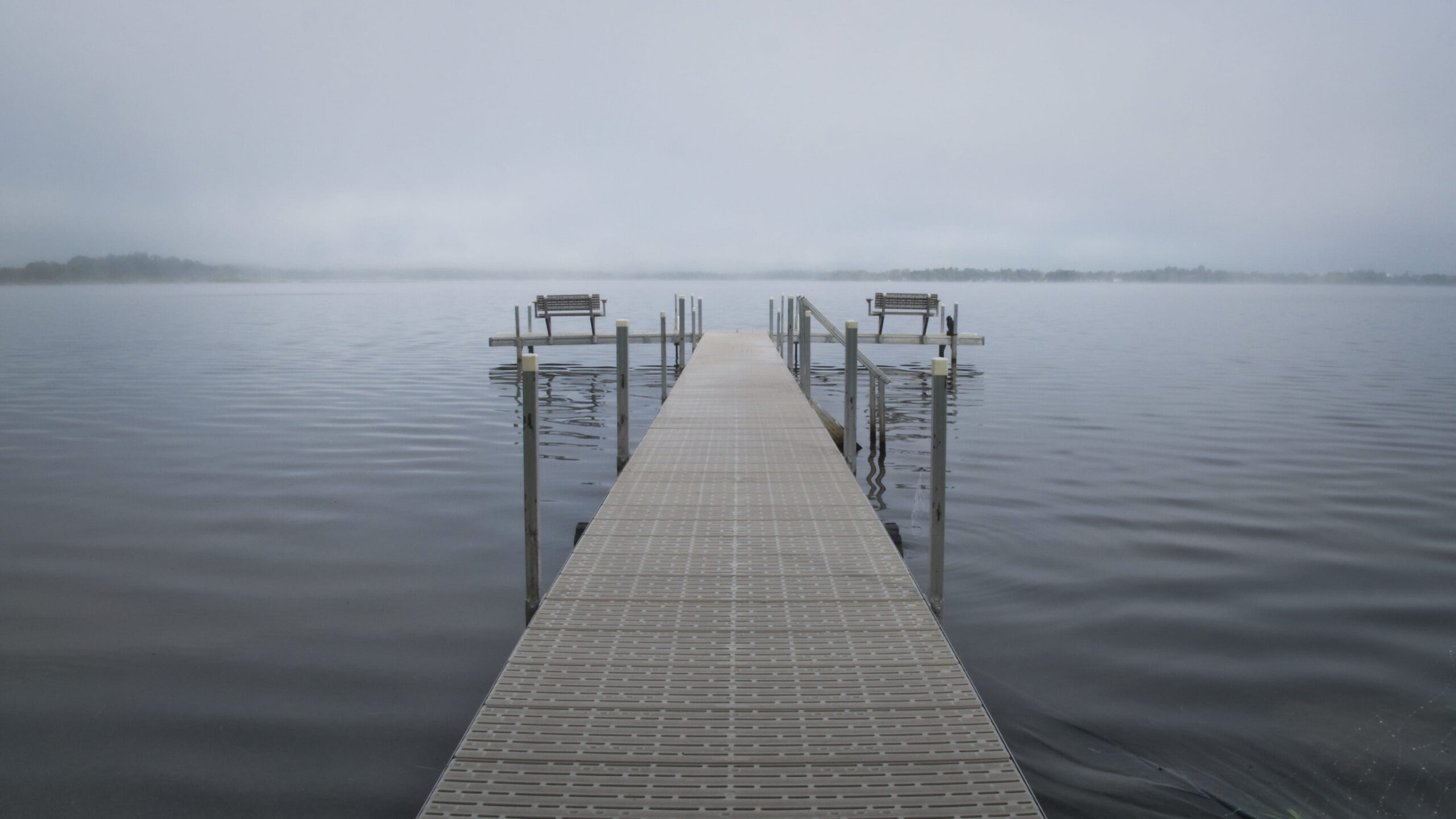
Anyone who owns lakefront property in Minnesota knows that Mother Nature doesn’t always cooperate. One week, you’re enjoying calm water and beautiful summer evenings. The next, heavy rainfall has raised the lake level, strong winds have sent waves crashing against your shoreline, and your dock needs adjusting.
That’s why choosing a dock for a Minnesota lake requires a little more consideration than simply picking out a style you like.
Quality Minnesota dock systems need to accommodate changing water levels, unpredictable weather, and different lake-bottom conditions. They must also meet the demands of seasonal installation and removal. In addition, they need to support everything from early-morning fishing trips to busy weekends with family and friends.
So, what separates a dock that’s simply attractive from one that’s well suited to Minnesota lake life? Let’s take a closer look at the construction features, materials, and design considerations that make a difference.
In warmer parts of the country, docks may remain in the water throughout the year. In Minnesota, seasonal changes play a much bigger role in dock ownership.
Spring brings ice-out and snowmelt. Summer brings thunderstorms, recreational boat traffic, and frequent use. Fall brings colder temperatures and seasonal removal, followed by months of winter storage.
A dock needs to be designed with this entire cycle in mind.
Heavy, cumbersome equipment can make seasonal installation and removal unnecessarily difficult. However, a dock that sacrifices structural strength to reduce weight may not provide the stability homeowners need.
Well-designed Minnesota lake docks balance strength, weight, functionality, and ease of seasonal handling. That combination becomes increasingly valuable after several years of ownership.
The materials used to build a dock have a considerable impact on its performance, maintenance requirements, and longevity.
Although traditional wooden docks have their appeal, aluminum has become a popular choice among Minnesota lake homeowners for several practical reasons.
Aluminum offers an excellent strength-to-weight ratio, making it particularly useful for equipment that needs to be moved seasonally.
A properly engineered aluminum frame can provide dependable structural support while remaining lighter than many comparable steel systems.
This can make transporting, installing, removing, and storing dock sections more manageable.
Considering how often Minnesota docks move in and out of the water, weight is an important factor rather than simply a matter of convenience.
Docks spend months exposed to rain, lake water, humidity, and changing temperatures. Over time, these conditions can take a toll on certain construction materials.
Aluminum naturally forms a protective oxide layer that helps resist corrosion. Unlike wood, it doesn’t rot. Unlike ordinary unprotected steel, it doesn’t develop traditional iron rust.
Although aluminum still requires appropriate maintenance, its moisture resistance makes it an attractive material for waterfront equipment.
Sidco Docks offers Tidal dock systems constructed with marine-grade aluminum, providing homeowners with options suited to seasonal freshwater environments.
When shopping for a dock, it’s easy to focus on appearance, size, and price. However, some of the most important features aren’t immediately noticeable.
The quality of the frame, welds, hardware, and connections can significantly influence how a dock performs over time.
The frame is the foundation of the dock. It distributes weight, supports the decking, and connects individual components.
Tidal sectional docks feature a dual-stringer design that provides additional structural support. Quality welded connections also contribute to the overall strength of the frame.
These construction details become especially important when several people are using the dock, equipment is being moved, or the system experiences repeated seasonal handling.
Small components can make a surprisingly big difference.
Fasteners, brackets, pins, and connection points experience regular movement and moisture exposure. When these components deteriorate, the entire dock can become less stable.
Tidal dock systems incorporate stainless steel and brass hardware to help resist corrosion and maintain dependable connections.
When comparing durable dock systems, look beyond the decking and consider how the individual components work together.
If you’ve lived on a Minnesota lake for any length of time, you’ve probably noticed how much water levels can change throughout the year.
Spring snowmelt and heavy rainfall can raise lake levels, while extended dry periods may cause them to drop.
A dock positioned perfectly in May might sit noticeably higher above the water by August.
Adjustable dock supports provide flexibility when conditions change. Depending on the system, homeowners or installers can modify the dock’s height and alignment without replacing major components.
However, every adjustable system has limitations. The range of adjustment should be appropriate for the property’s typical water depths and seasonal fluctuations.
Floating docks offer another approach by moving vertically with changing water levels. Their suitability depends on water depth, anchoring requirements, shoreline access, and exposure to waves.
One of the most important factors when selecting docks for Minnesota lakes is the lake bottom. Homeowners can’t always see it.
A sandy, gradually sloping lakebed presents different installation challenges than a rocky shoreline or an area with deep, soft sediment.
Stationary docks rely on their supports to maintain stability. If those supports settle unevenly into soft sediment, the dock may require additional adjustments.
Rocky lakebeds can make positioning and leveling supports more challenging. Steep underwater slopes may also limit which configurations are practical.
Taking these conditions into account before purchasing a dock can help prevent unnecessary modifications later.
Even two neighboring properties on the same lake may benefit from different dock designs.
Your waterfront needs today may look considerably different five or ten years from now.
Perhaps you’ll purchase a larger boat, add a personal watercraft, or decide you need additional room for swimming and entertaining.
Modular Minnesota dock systems give homeowners the flexibility to make changes as their needs evolve.
Instead of replacing the entire dock, compatible sections and accessories can often be added or rearranged.
Tidal sectional docks feature an integrated track rail system. It allows flexible configurations and accessory placement. Sections come in several lengths and widths, giving homeowners layout options.
This approach can be particularly useful for families who want to improve their waterfront gradually rather than completing every upgrade at once.
Think about everything your dock experiences during a typical summer weekend.
Kids run across it after swimming. Fishing gear gets dropped on it. Coolers are dragged to the boat. Wet feet, sunshine, rain, and muddy sandals all become part of the routine.
Dock decking needs to accommodate real-life use while remaining comfortable and relatively easy to maintain.
When comparing decking materials, consider traction, surface temperature, moisture resistance, and cleaning requirements.
Synthetic decking options can reduce concerns associated with wood rot and splintering. However, performance varies by material, color, and surface texture.
Removable decking panels can also simplify certain maintenance tasks and reduce the weight of individual dock sections during seasonal handling.
Even the most durable dock systems have limitations.
A dock constructed with strong aluminum framing and high-quality hardware isn’t necessarily designed to withstand the pressure of moving lake ice.
As lake ice expands and shifts, it can generate tremendous force against waterfront structures. The Minnesota Department of Natural Resources identifies ice heaving as a significant cause of damage. It can damage docks, boat lifts, retaining walls, and other shoreline property.
For typical seasonal docks, removing equipment before freeze-up is one of the most practical ways to reduce this risk.
That’s another reason manageable dock weight and modular construction are valuable features in Minnesota.
Following manufacturer recommendations for removal and winter storage helps protect the equipment and preserve its useful life.
A dock should improve access to the lake without unnecessarily disrupting the surrounding environment.
Minnesota has regulations governing dock placement, dimensions, navigation, and potential impacts on aquatic habitat.
Many residential docks don’t require an individual DNR permit when they meet established conditions. However, larger platforms and certain configurations may require additional authorization.
Local requirements may also apply.
Before expanding or replacing a dock, homeowners should consider the planned dimensions, neighboring properties, aquatic vegetation, and access to navigable water.
A well-planned layout can meet recreational needs while respecting the lake and its surrounding ecosystem.
The Brainerd Lakes Area offers everything from small, sheltered lakes to large bodies of water exposed to considerable wind and wave action.
Understanding these differences is an important part of selecting and installing waterfront equipment.
A local dock provider familiar with Minnesota lake conditions can help homeowners evaluate construction options, shoreline accessibility, water depth, seasonal handling, and future expansion opportunities.
Sidco Docks combines dock and boat lift sales with seasonal installation, removal, repairs, storm recovery, and barge services.
This experience provides a broader understanding of how different dock systems perform throughout their ownership cycle. It also shows how they look when workers first install them.
Choosing the right dock is about more than finding the strongest frame or the most attractive decking.
The best Minnesota dock systems combine durable materials, thoughtful construction, adjustable supports, flexible configurations, and manageable seasonal handling.
They accommodate the realities of Minnesota’s changing weather while supporting the way homeowners actually enjoy their waterfront.
Your ideal summer may involve fishing at sunrise, taking the pontoon out with friends, watching the kids swim, or simply relaxing by the water. Your dock should make those experiences easier.
After all, Minnesota summers are short enough. The less time you spend worrying about your dock, the more time you have to enjoy the lake.
Based in Pillager, Minnesota, Sidco Docks provides quality Tidal dock and boat lift systems throughout the Brainerd Lakes Area and surrounding communities.
As an authorized Tidal Docks and Lifts dealer, Sidco offers new dock and lift sales, professional installation, seasonal removal, repairs, storm recovery, and barge services.
Whether you’re exploring options for a new waterfront setup or considering upgrades to an existing dock, Sidco Docks can provide information about equipment and configurations suited to your Minnesota lake property.
Sidco Docks
Location: Pillager, Minnesota
Phone: (218) 838-7179
Email: yourdockguy@hotmail.com