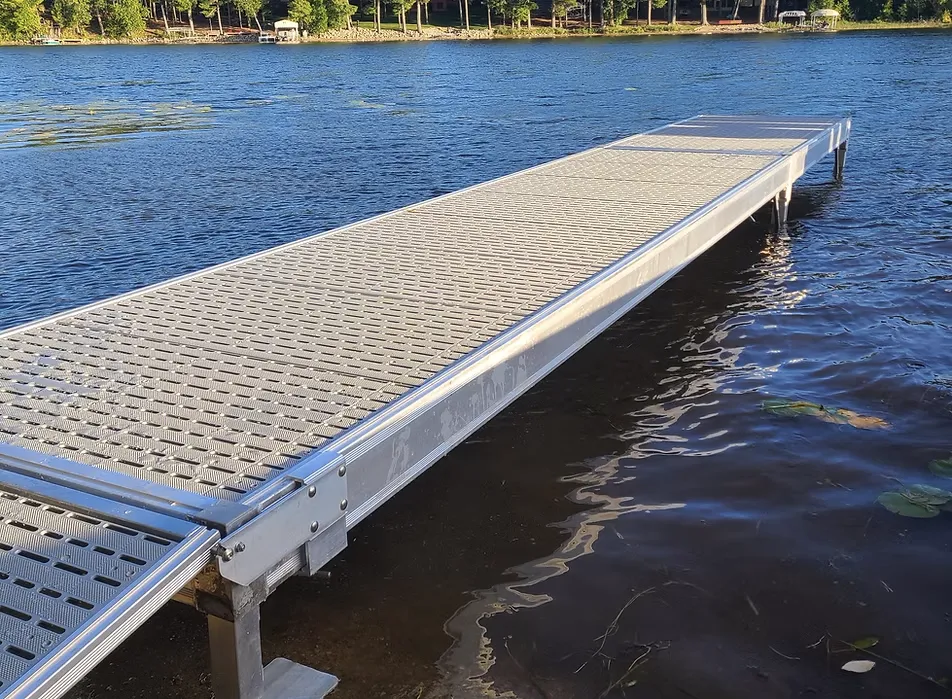
Every dock eventually reaches a point when a homeowner starts asking the same question.
Additionally, in deciding dock repair vs replacement, consider cost, durability, and long-term value.
Maybe a few boards need attention. Perhaps the dock feels less stable than it used to, or you’re spending more time making adjustments than enjoying the lake. What started as occasional maintenance may now feel like an annual project.
For Minnesota lake homeowners, deciding between dock repair vs replacement isn’t always straightforward.
Additionally, it depends on factors such as the dock’s condition, costs, and expected lifespan.
The good news is that an aging dock doesn’t automatically need replacing. Some issues are relatively simple to address, while others suggest that investing in a new system may be the better long-term decision.
The aging dock does not automatically need replacement, which is good news.
Understanding the difference can help you make a practical choice for your waterfront. It informs your budget and future lake activities.
Before deciding whether to repair or replace an old dock, start with its overall condition.
A dock with a strong frame and a few worn components presents a different situation than one with significant structural damage.
Consider three important questions:
These questions help separate routine maintenance from more serious concerns.
A professional inspection can be particularly useful when damage involves the frame, supports, or connections. Cosmetic wear may be obvious, but structural problems aren’t always easy to evaluate from the walking surface.
Not every worn dock needs a complete replacement.
In many cases, dock repair in Minnesota can extend the useful life of a system that’s otherwise in good condition.
Loose or damaged decking may be repairable when the underlying frame remains sound.
Depending on the dock material and design, individual boards, panels, or fasteners may be replaceable without rebuilding the entire system.
However, widespread deterioration may indicate that a larger investment is necessary.
Dock hardware experiences considerable movement and exposure throughout the boating season.
Bolts, brackets, pins, and other components may eventually need adjustment or replacement.
If the frame and supports remain in good condition, replacing compatible hardware can often restore proper function.
Sometimes a storm, impact, or handling issue damages one section of a dock.
If replacement parts are available and the remaining system is structurally sound, repairing the affected component may be more economical than replacing everything.
The key is determining whether the damage is truly isolated.
Some problems suggest that continued repairs may no longer be the most practical option.
Recognizing the signs a dock needs replacement can help homeowners avoid repeatedly investing in equipment that’s approaching the end of its useful life.
Bent frames, cracked structural components, severely deteriorated supports, or extensive corrosion deserve careful attention.
Structural problems may affect the dock’s ability to support normal use safely.
When damage extends across multiple sections, replacement may be more practical than attempting extensive repairs.
A dock shouldn’t feel consistently unstable during normal use.
Some movement is expected with certain dock designs, particularly floating systems. However, unusual wobbling, sagging, shifting, or uneven surfaces may indicate problems.
If repeated adjustments haven’t resolved the issue, the dock may need more than routine maintenance.
Occasional repairs are part of owning waterfront equipment.
However, when the same problems return every season, it’s worth considering whether the money would be better invested in a newer system.
Repeated repairs can also create inconvenience during the limited Minnesota boating season.
One of the most important factors in the dock repair vs replacement decision is cost.
A relatively inexpensive repair may be worthwhile when the dock has many useful seasons remaining.
However, several repairs performed over multiple years can add up.
Rather than looking at the next repair bill alone, consider the larger picture.
Review what you’ve spent on repairs during the past few seasons and estimate what additional maintenance may be necessary.
Then compare that amount with the cost of a replacement system.
A new dock generally requires a larger upfront investment.
However, an aging system may continue generating repair expenses, seasonal labor, and inconvenience.
The most economical decision isn’t always the one with the lowest immediate cost.
Consider expected service life, maintenance requirements, replacement-part availability, and how long you plan to use the property.
A repair that provides several dependable seasons may offer excellent value. A costly repair that only postpones replacement briefly may not.
Age is worth considering, but it shouldn’t determine the decision by itself.
An older dock that’s been properly maintained may remain functional for many years. A newer dock exposed to severe storms, improper handling, or unusual conditions may experience problems much sooner.
Materials also matter.
Wood, aluminum, and composite dock components have different maintenance needs and deterioration patterns.
Instead of relying on a specific age cutoff, evaluate the dock’s actual condition.
Look at the frame, supports, connections, decking, and overall stability.
The question isn’t simply how old the dock is. It’s whether the aging dock system can continue providing safe, dependable service.
Sometimes replacement makes sense even when the existing dock isn’t severely damaged.
Your waterfront needs may have changed since the dock was installed.
Perhaps you’ve purchased a larger pontoon, added another watercraft, or started using the dock for swimming and entertaining.
A layout that worked years ago may no longer be convenient.
Think about how your family uses the lake today.
Do you need additional walking space? Better access to a boat lift? A different configuration for swimming or fishing?
Could a different dock design make seasonal installation easier?
If the existing system can’t accommodate those needs, upgrading may provide more value than continuing to repair an outdated layout.
Minnesota weather can create difficult conditions for waterfront equipment.
Strong winds, waves, floating debris, and winter ice movement may damage dock components.
The Minnesota Department of Natural Resources explains that ice heaving can exert significant pressure against shoreline structures, including docks and boat lifts.
Following major damage, the decision to repair or replace depends on how extensively the equipment has been affected.
A damaged accessory or isolated section may be replaceable.
A twisted frame or multiple compromised supports may present a different situation.
Avoid using a dock with suspected structural damage until it has been properly evaluated.
Purchasing a new dock in Minnesota can provide advantages beyond replacing worn equipment.
Modern dock systems may offer improved layouts, durable materials, easier seasonal handling, and accessories that better match how homeowners use their waterfront.
Sidco Docks offers Tidal dock systems and related waterfront equipment for Minnesota lake properties.
When considering replacement, it’s helpful to compare options based on shoreline conditions rather than appearance alone.
Water depth, lake-bottom conditions, shoreline slope, and exposure to wind and waves can influence which dock design is appropriate.
A system that works well on one lake may not be the best choice for another property.
For many Minnesota homeowners, docks must be installed and removed each season.
A replacement system that’s easier to handle may reduce some of the physical demands associated with seasonal maintenance.
The right design depends on the property and the equipment involved.
Sometimes homeowners don’t need to choose between repairing one component and replacing the entire dock.
Partial replacement may be possible.
For example, a manufacturer may offer compatible replacement sections, decking, hardware, or accessories.
However, compatibility matters.
Combining components from different systems without confirming proper fit and structural requirements can create problems.
Before purchasing replacement sections, verify the dock’s manufacturer, model, dimensions, and connection design.
If compatible components are unavailable, a more extensive upgrade may be necessary.
A dock replacement project is also an opportunity to evaluate the boat lift.
If you’re changing the dock layout, purchasing a different boat, or upgrading your waterfront access, the existing lift may need adjustment or replacement.
Consider the watercraft’s loaded weight, dimensions, and the lift’s rated capacity.
Inspect the lift frame, cables, bunks, guides, and operating components.
Sidco Docks offers Tidal hydraulic boat and pontoon lifts in multiple capacities, making it possible to evaluate dock and lift needs together.
Coordinating these decisions can help create a waterfront setup that works as a complete system.
Before replacing a dock with a different size or configuration, review applicable regulations.
The Minnesota DNR explains that many residential docks don’t require an individual permit when they meet specific requirements.
These include restrictions involving dock width, length, navigation, environmental impacts, and other conditions.
Local government rules may also apply.
A replacement dock with a substantially different footprint or platform design may require additional consideration.
Understanding these requirements before purchasing equipment can help avoid unnecessary complications.
If you’re still deciding what to do with an older dock, use these questions as a starting point:
Your answers can help clarify whether repairs are reasonable or replacement deserves serious consideration.
The choice between dock repair vs replacement doesn’t have to be an all-or-nothing decision based on age alone.
A well-maintained dock with minor damage may have years of useful service remaining. Repairing decking, hardware, or individual components can be a practical way to extend its life.
However, widespread structural problems, recurring repairs, difficult seasonal handling, or changing waterfront needs may make replacement the better long-term investment.
The most useful approach is to evaluate the dock’s condition, understand the expected cost of repairs, and consider how you want to use your waterfront in the years ahead.
A dependable dock should make Minnesota lake life easier—not become another ongoing source of frustration.
Sidco Docks is based in Pillager, Minnesota, and serves lakefront property owners throughout the Brainerd Lakes Area and surrounding communities.
The company provides Tidal dock and boat lift sales, spring installation, fall removal, repairs, storm recovery, and barge services.
For homeowners evaluating an aging dock, considering repairs, or researching replacement systems, Sidco Docks can provide information based on the equipment’s condition and the individual waterfront property.
Sidco Docks
Location: Pillager, Minnesota
Phone: (218) 838-7179
Email: yourdockguy@hotmail.com