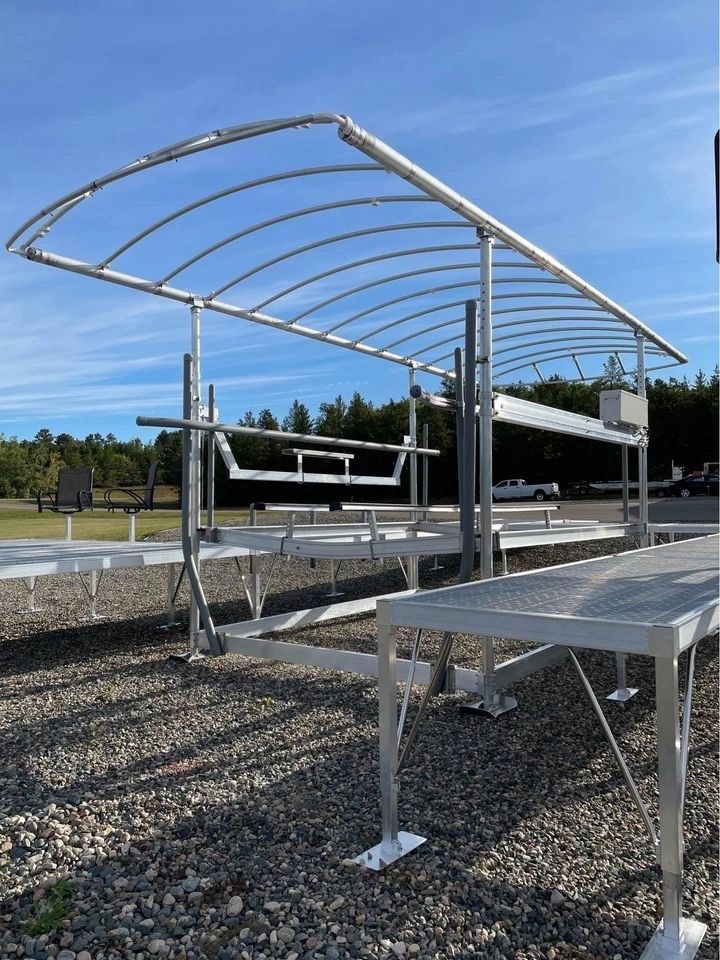
As another Minnesota boating season comes to an end, lake homeowners begin tackling their annual fall checklist. The boat needs winterizing, outdoor furniture gets stored, and the dock may need to come out. But what about the boat lift? Is removing it really necessary, or can it safely stay in the water until spring?
It’s a reasonable question, especially when you own a heavy-duty aluminum lift that seems more than capable of handling Minnesota weather.
The reality is that boat lift winter Minnesota conditions can be challenging, even for durable waterfront equipment. Freezing temperatures, expanding ice, shifting water levels, and powerful ice movement can place tremendous pressure on boat lift components.
While certain specialized lift systems may be designed for year-round installation, most seasonal boat lifts should be removed before the lake freezes unless the manufacturer specifically approves leaving them in place.
Understanding the risks of leaving a boat lift in the water throughout winter can help Minnesota lake homeowners make informed decisions about protecting their equipment.
The short answer is that it depends on the lift’s design, the manufacturer’s instructions, and the conditions of the lake. However, removal is generally the safer choice for seasonal boat lifts in Minnesota.
Boat lifts are designed to support watercraft and provide convenient access during the boating season. That doesn’t automatically mean they’re engineered to withstand months of freezing conditions and moving lake ice.
Even lifts built with marine-grade aluminum and corrosion-resistant components can be vulnerable to the enormous forces created by ice.
A lift that performs beautifully during summer may experience very different stresses when frozen into a lake.
Before deciding to leave any lift installed, review the manufacturer’s winter recommendations. If the equipment isn’t specifically approved for winter installation, seasonal removal is the more prudent approach.
Minnesota lakes undergo significant seasonal changes. Water temperatures fall, ice forms, and the lake gradually transitions into an environment where ordinary boating equipment no longer operates as intended.
The most serious concern isn’t simply cold temperatures. It’s what happens when water freezes and ice begins moving.
When water freezes, it expands. Across a large lake, changing temperatures and ice conditions can generate considerable pressure.
The Minnesota Department of Natural Resources describes a phenomenon known as ice heaving or ice jacking. This occurs when expanding and moving lake ice pushes against shorelines and structures.
Ice movement can be powerful enough to damage docks, boat lifts, retaining walls, and other shoreline property.
A lift positioned in the path of moving ice may experience forces far beyond those created by normal waves and boat traffic.
Water levels can change during winter, and periods of warming and cooling can affect ice conditions.
If ice forms around a boat lift and subsequently shifts, the surrounding structure may experience uneven pressure.
These conditions are difficult to predict, which makes leaving seasonal equipment in the lake a gamble.
One reason boat lift ice damage is concerning is that problems may affect several parts of the system.
A lift doesn’t necessarily need to be completely destroyed for winter damage to create expensive or inconvenient repairs.
Potential problems include bent frames, damaged supports, shifted components, distorted connections, and damage to lift mechanisms.
The exact consequences depend on the lift’s construction and the severity of the ice movement.
Boat lift frames are designed to support specific loads under normal operating conditions. Moving ice can apply pressure from directions the equipment wasn’t intended to withstand.
This may bend supports, affect frame alignment, or shift the lift from its original position.
Some boat lifts use cables, pulleys, hydraulic components, or other mechanisms to raise and lower watercraft.
Ice movement that distorts the frame or other structural components may also affect the alignment or operation of those mechanisms.
Any lift exposed to significant ice pressure should be inspected before returning it to service.
Guides, bunks, steps, canopy frames, and other accessories can also be vulnerable when equipment shifts or becomes trapped in ice.
These components are important to everyday lift operation, so damage may affect how the boat is supported or positioned.
Aluminum is a popular material for boat lifts because it offers durability, corrosion resistance, and a favorable strength-to-weight ratio.
Sidco Docks offers Tidal hydraulic boat and pontoon lifts constructed with marine-grade aluminum. These systems also feature stainless steel cables and hydraulic components positioned above the water.
Those design features offer advantages during normal waterfront use.
However, corrosion resistance and resistance to ice pressure are not the same thing.
A high-quality aluminum lift can still be damaged by moving ice. Strong construction doesn’t automatically make a seasonal lift suitable for remaining in a frozen lake.
Homeowners should evaluate winter suitability based on the manufacturer’s specifications rather than assuming the lift’s material alone provides adequate protection.
Yes. Certain specialized or permanently installed lift systems may be engineered for year-round use in specific environments.
However, these systems shouldn’t be confused with ordinary seasonal lifts.
Whether a lift can remain installed depends on its engineering, foundation or anchoring system, manufacturer requirements, and site-specific ice conditions.
A permanent installation may also involve different permitting or regulatory considerations.
If you’re considering a year-round lift, it’s important to verify that the exact model is approved for those conditions. Local lake characteristics should also be evaluated.
For typical seasonal boat and pontoon lifts, Minnesota boat lift removal remains the more common preventive approach.
There isn’t one universal date that works for every Minnesota lake.
Fall weather varies, and different lakes can freeze at different times. Even protected areas of the same lake may begin developing ice before more exposed sections.
The practical goal is to remove seasonal equipment before the first hard freeze and before significant shoreline ice develops.
Waiting until ice appears around the lift can make removal more complicated and potentially unsafe.
Homeowners should monitor extended forecasts, consider when boating activities have ended, and arrange removal while water and shoreline conditions remain manageable.
Sidco Docks provides seasonal dock and lift removal services, with scheduling based on customer preferences and weather forecasts.
Planning ahead offers more flexibility than waiting for an approaching cold snap.
Sometimes Minnesota weather changes faster than expected.
A homeowner may plan to remove the lift during an upcoming weekend, only to discover that overnight freezing temperatures have already created ice around the shoreline.
If that happens, avoid trying to force the equipment free.
Pulling or lifting a structure that is frozen into place can create additional stress on its components. Working around newly formed ice also introduces safety concerns.
The appropriate solution depends on the lift design, ice conditions, water depth, and available removal equipment.
If the lift has become frozen in place, professional evaluation may be necessary. Never walk onto uncertain ice or attempt a dangerous recovery simply to avoid leaving the equipment temporarily in place.
For seasonal systems, one of the most effective ways to protect a boat lift during winter is to remove it before freezing conditions become established.
However, removal is only one part of proper seasonal care.
A good fall maintenance routine should include inspecting the lift, cleaning components, identifying needed repairs, and following the manufacturer’s storage instructions.
Look for visible damage to the frame, hardware, cables, guides, bunks, and other accessible components.
Pay attention to unusual wear, corrosion, bent parts, loose connections, or changes in alignment.
Hydraulic and electrical systems should be inspected and prepared according to the specific manufacturer’s procedures.
Boat lifts can collect aquatic vegetation, algae, mud, and other debris during the summer.
Cleaning equipment before storage makes inspection easier and helps prevent unwanted material from remaining on components throughout the winter.
Canopies, curtains, and removable accessories may require separate cleaning and storage.
Follow the manufacturer’s recommendations for fabric, frames, electrical components, and other accessories. Do not assume every canopy or curtain system can safely remain attached during storage.
After removal, winter boat lift storage should be planned around the equipment’s design and the available space.
A suitable storage location should provide stable support and reduce the risk of accidental damage from vehicles, snow removal equipment, falling branches, or other winter activity.
Smaller accessories and removable components should be organized so they’re easy to locate in spring.
If repairs are needed, document them during fall removal. This provides time to identify replacement parts before the next boating season.
Proper storage doesn’t eliminate every maintenance requirement, but it helps keep the lift organized and ready for inspection when spring returns.
Removing a boat lift can be more complicated than homeowners initially expect.
Lifts can be large, awkward to maneuver, and difficult to access from shore. Water depth, lake-bottom conditions, shoreline slope, and equipment size can all influence the removal process.
Sidco Docks provides professional spring installation and fall removal for docks and lifts throughout the Brainerd Lakes Area and surrounding communities.
The company also operates two barges equipped with hydraulic lifts for waterfront work, including transporting and positioning dock equipment.
Professional seasonal service can be especially helpful when a property has limited shoreline access, a larger lift system, or multiple pieces of waterfront equipment requiring removal.
For many homeowners, coordinating dock and lift removal together makes the transition into winter more manageable.
Fall removal also creates an opportunity to prepare for the following boating season.
After months of use, a lift may have developed worn cables, damaged bunks, loose hardware, or other maintenance needs.
Addressing those concerns during the off-season can prevent unnecessary delays when the lake opens in spring.
It’s also a good time to reconsider whether the existing lift still matches your watercraft.
Sidco Docks offers Tidal hydraulic boat and pontoon lifts with capacities ranging from 4,000 to 8,000 pounds. Homeowners considering a larger boat or pontoon should verify the watercraft’s loaded weight, dimensions, and lift requirements before assuming the current system remains suitable.
A little planning during winter can make the next spring installation considerably easier.
Before closing your waterfront for the season, review these important steps:
When moving used equipment between water bodies, remember Minnesota’s aquatic invasive species requirements, including the applicable 21-day out-of-water period before placing docks, lifts, or rafts into a different waterbody.
So, can you leave a boat lift in the water all winter?
For a typical seasonal boat lift on a Minnesota lake, removal before freeze-up is generally the safer and more practical choice.
Even strong, well-built lifts can be vulnerable to the forces created by expanding and moving ice. Leaving equipment in the lake may expose frames, supports, cables, and accessories to damage that could have been avoided through seasonal removal.
Specialized systems designed for year-round installation may be different, but their suitability should always be confirmed with the manufacturer and evaluated for local conditions.
For Minnesota lake homeowners, proper winter preparation means understanding the equipment, planning removal at the right time, inspecting components, and storing everything appropriately.
Protecting your boat lift in fall helps make it easier to return to the water when another Minnesota boating season finally arrives.
Sidco Docks is based in Pillager, Minnesota, and serves lakefront property owners throughout the Brainerd Lakes Area and surrounding communities.
The company provides Tidal dock and boat lift sales, spring installation, fall removal, repairs, storm recovery, and barge services. Its seasonal services help homeowners manage their waterfront equipment as lake conditions change throughout the year.
For questions about boat lift winter preparation, seasonal removal, maintenance, or selecting a replacement lift:
Sidco Docks
Location: Pillager, Minnesota
Phone: (218) 838-7179