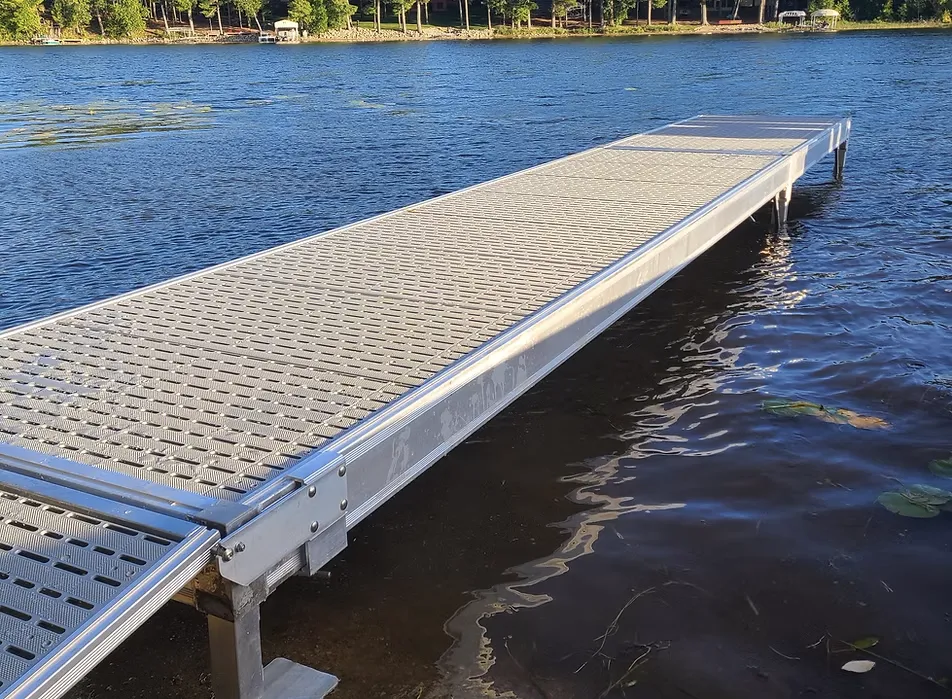
For Minnesota lakefront property owners, improving the waterfront often begins with one simple idea: maybe the old dock needs to be replaced, the boat needs a better lift, or the shoreline setup simply isn’t working as well as it could. Once the planning begins, however, it quickly becomes clear that a dock, boat lift, and waterfront accessories don’t function independently. They work together as one complete system.
That is why a complete waterfront upgrade is often best planned as a whole rather than one piece at a time. The location and layout of your dock can influence where the boat lift belongs. Your watercraft determines the capacity and configuration of the lift. Water depth and lake-bottom conditions affect both dock and lift placement. Accessories can improve safety and convenience, while seasonal installation and removal should be considered before everything reaches the water.
For lake homeowners throughout the Brainerd Lakes area and Central Minnesota, thoughtful waterfront planning can result in a setup that is easier to use, better suited to the property, and more adaptable as boating needs change.
Before comparing dock styles or boat lift specifications, think about how your family actually uses the lake.
For some homeowners, boating is the priority. The dock primarily needs to provide a convenient path between the house and the boat, with a lift positioned for easy arrival and departure. Other families spend just as much time swimming, fishing, relaxing, launching kayaks, or sitting by the water as they do boating.
Your ideal waterfront layout might need to accommodate several activities at once.
Consider whether you regularly use the waterfront for boating, swimming, fishing, paddle boarding, kayaking, entertaining, or simply sitting near the water. Think about the number and type of watercraft you own today and whether those needs are likely to change.
Planning around real use helps prevent a common problem: installing a dock that technically reaches the water but doesn’t function particularly well for the people using it.
Every complete dock and lift project should begin with the property itself.
Minnesota shorelines vary dramatically. One lake home may have a gradual sandy bottom that stays shallow for a considerable distance, while another property reaches deep water only a few feet from shore. Rock, gravel, soft sediment, changing water levels, wind exposure, and wave activity can all influence the best waterfront configuration.
Water depth is especially important. A dock should generally extend only as far as needed to provide useful access to navigable water, while the boat lift needs sufficient depth for the watercraft to enter and exit safely.
Lake-bottom conditions also affect equipment placement. A stable sandy or gravel bottom can present different installation considerations than uneven rock or softer sediment.
Rather than choosing a dock from a catalog and trying to make the shoreline fit the equipment, a better approach is to evaluate the shoreline first and then select a system suited to those conditions.
The dock establishes the basic structure of your waterfront setup. It determines how people move between shore and water, where boats can approach, where the lift can be positioned, and how recreational areas can be arranged.
Sidco Docks offers Tidal dock systems designed for Minnesota waterfront properties, including stationary and floating dock options. When planning a new dock, homeowners should consider more than overall length.
Width, configuration, stability, access points, and intended use all matter. A simple straight dock may be appropriate for a property focused primarily on boat access, while other waterfronts may benefit from a configuration that creates additional room for swimming, fishing, seating, or access to multiple watercraft.
The goal isn’t necessarily to build the largest dock possible. A well-designed dock uses available space efficiently and supports how the waterfront will actually be enjoyed.
One of the strongest reasons to plan a dock and boat lift upgrade together is that the two systems need to complement one another.
The lift should be positioned where there is adequate water depth and comfortable access from the dock. The boat needs enough room to approach the lift without creating unnecessary maneuvering challenges, and passengers should be able to board and exit safely.
Choosing the boat lift itself begins with the watercraft.
Important specifications include the boat’s loaded weight, length, beam, hull or pontoon configuration, engine, fuel, batteries, and permanently installed equipment. Sidco Docks currently offers Tidal hydraulic boat and pontoon lifts with different capacities, allowing the lift to be matched to various watercraft.
Capacity should never be based on boat length alone. Two boats of similar size can differ considerably in total weight because of engines, fuel, batteries, accessories, and construction.
Planning the lift alongside the dock helps ensure that capacity, physical fit, water depth, and dock access all work together.
A complete waterfront upgrade is usually intended to last longer than a single boating season, and possibly longer than the boat currently sitting at your property.
If you know that a larger pontoon, fishing boat, or other watercraft is likely in the near future, include that information during planning. An upcoming change in boat size could affect lift capacity, canopy dimensions, dock positioning, or the amount of space needed for maneuvering.
The same applies to additional recreational equipment. A family that currently owns one pontoon may eventually add kayaks, paddle boards, personal watercraft, or fishing boats.
You don’t need to design the entire waterfront around hypothetical purchases, but known future plans can help prevent an expensive layout change a year or two after installation.
Dock and lift accessories can dramatically improve everyday use, but the best accessories solve a real problem or add useful convenience.
Sidco Docks currently lists a variety of Tidal lift accessories, including pontoon bunk systems, deck lift kits, guides, lift steps, motor stops, bow stops, and other lift components.
For boat and pontoon owners, guides can make positioning the watercraft on the lift easier, particularly on windy days or in areas affected by waves and boat traffic. Proper bunks help support the watercraft, while a lift step may make boarding and exiting more convenient.
Accessories should be considered while planning the overall system instead of automatically added afterward. Knowing what you want early can influence dock spacing, lift setup, and the amount of working room needed around the boat.
For many lake homeowners, the boat lift canopy is another important component of a complete waterfront setup.
A canopy provides protection from sun, rain, and debris while the boat is stored on the lift. Sidco Docks offers Tidal aluminum canopy frames in multiple lengths and configurations, along with fabric options and electric curtain systems.
The appropriate canopy should be chosen for the actual watercraft and lift configuration. Boat length is important, but features such as extended decks, swim platforms, pontoon layouts, and outboard motors may also influence the amount of coverage desired.
Planning the canopy at the same time as the boat lift allows the entire system to be evaluated together.
A successful waterfront upgrade should make lake access easier, not more complicated.
Think about how people will move from shore to dock, from dock to boat, and from dock to water. Walking paths should remain clear, frequently used areas should feel stable, and accessories shouldn’t create unnecessary obstacles.
Families who swim frequently may want convenient access to a ladder or swimming area. Boat owners may prioritize the location of lift steps and guide systems. Those who fish from the dock may want enough open space to comfortably cast without interfering with boat access.
Safety also includes maintaining clear navigation around the waterfront. Dock and lift placement should allow boats to maneuver without creating unnecessary conflicts with neighboring waterfront use.
A practical layout often feels simple because each part of the system has a clear purpose.
Waterfront improvements should also account for Minnesota regulations.
Many residential docks can be installed without a Minnesota DNR public waters permit when they meet applicable requirements. Generally, qualifying docks should not create a navigation or safety hazard, interfere with water flow, extend farther than reasonably necessary for their intended use, or violate applicable local requirements.
Certain dock sizes, configurations, shoreline alterations, or projects involving aquatic vegetation may require additional review or permits.
Because individual waterfront projects can vary, homeowners should check current Minnesota DNR guidance and applicable local regulations before beginning an installation.
Planning for these considerations early is much easier than redesigning a waterfront project after equipment has been purchased.
Minnesota’s aquatic invasive species requirements are particularly important when purchasing used docks or lifts or moving waterfront equipment between lakes.
Docks, lifts, and rafts removed from one waterbody must remain out of the water for at least 21 days before being placed into another waterbody. Equipment should also be inspected and cleaned to remove aquatic plants and prohibited invasive species.
This can affect project timing if part of your waterfront upgrade involves moving equipment from another lake.
When professional lake service providers install or remove water-related equipment, Minnesota also requires applicable service provider permitting and aquatic invasive species training.
These rules help protect Minnesota lakes while preventing the unintended spread of invasive species.
A Minnesota waterfront upgrade isn’t complete until you’ve considered what happens at the end of the boating season.
Sidco Docks provides spring installation and fall removal services for docks and lifts. During spring installation, components can be inspected and positioned for the upcoming season. During fall removal, equipment can be taken out before hard-freeze conditions expose it to Minnesota winter ice.
This seasonal cycle should influence equipment selection.
A system that looks impressive in July may be less appealing if installation and removal are unusually complicated every spring and fall. Considering seasonal service from the beginning can make long-term ownership considerably easier.
Professional removal also provides a natural opportunity to identify damaged or worn components before the next boating season.
Even quality dock and boat lift equipment benefits from regular inspection and maintenance.
Dock hardware, structural components, decking, lift cables, bunks, guides, canopies, and accessories should be checked periodically for wear or damage. Storms can also create unexpected issues, especially when strong winds and waves place additional stress on waterfront equipment.
Sidco Docks provides repair and storm recovery services in addition to installation and removal. The company also operates barges equipped with hydraulic lifts for waterfront work.
Thinking about future service during the initial planning stage creates a more complete ownership strategy. Your waterfront setup isn’t simply something installed once and forgotten; it is equipment that operates in a demanding outdoor environment and should be maintained accordingly.
Some lake properties are difficult to reach from land. Others involve heavy equipment or waterfront projects that are more efficiently handled from the water.
Sidco Docks operates two barges with hydraulic lifts that can transport and position docks and assist with other waterfront work. Its barge services also include transporting heavy items, assisting with certain shoreline maintenance projects, recovering sunken items, and storm recovery.
For properties with challenging access, understanding what equipment may be available can influence how a complete waterfront upgrade is planned.
It may also make projects possible that would be difficult to complete using shoreline access alone.
One of the easiest ways to create an awkward waterfront is to purchase each component independently.
A homeowner buys a dock first, then a lift the following year, adds a canopy later, and eventually discovers there isn’t enough space for the configuration they really wanted.
Planning the complete system from the beginning allows you to answer important questions before installation:
Does the dock reach appropriate water depth? Is there enough room for the lift? Can the boat comfortably enter the lift? Is passenger access convenient? Will a canopy fit properly? Are future accessories likely? Will the system be manageable during seasonal installation and removal?
Not every component needs to be purchased at the same time. What matters is having a long-term plan so today’s decisions don’t unnecessarily limit tomorrow’s options.
A dock and lift system is ultimately there to support the way you enjoy the lake.
That means practical considerations such as weight capacity, water depth, structural stability, and regulatory requirements are essential—but they aren’t the entire story.
A well-planned waterfront can also make ordinary lake days easier. Boarding the boat takes less effort. Swimming access feels more natural. Gear has a logical place. The boat is protected when it isn’t being used, and the dock becomes a comfortable transition between the property and the water.
The most successful waterfront upgrades balance engineering and practicality with the lifestyle that made owning lake property appealing in the first place.
There isn’t one universal dock, boat lift, or accessory package that’s right for every Minnesota lake home.
A complete waterfront upgrade should begin with the shoreline, the watercraft, and the people who use the property. From there, the dock can establish the layout, the boat lift can be matched to the watercraft and water depth, and accessories can be selected to improve protection, access, and convenience.
For Minnesota homeowners, seasonal installation and removal, winter conditions, environmental requirements, and long-term maintenance should also be part of the conversation.
Planning everything as one coordinated waterfront system can reduce compromises, make future upgrades easier, and create a setup that functions better from the first spring installation through the final fall removal.
For lake property owners throughout the Brainerd Lakes area, that thoughtful approach can turn a collection of dock and lift equipment into a waterfront that truly fits the property.
Sidco Docks is based in Pillager, Minnesota, and provides dock and boat lift solutions for lakefront property owners throughout the Brainerd Lakes area and surrounding communities. Current services include new Tidal dock and lift sales, professional spring installation, fall removal, repairs, storm recovery, and barge services. Sidco also offers boat lift accessories and waterfront equipment designed to complement its dock and lift systems.
For questions about planning a dock, boat lift, accessories, or a complete waterfront setup:
Sidco Docks
Location: Pillager, Minnesota
Phone: (218) 838-7179
Email: yourdockguy@hotmail.com