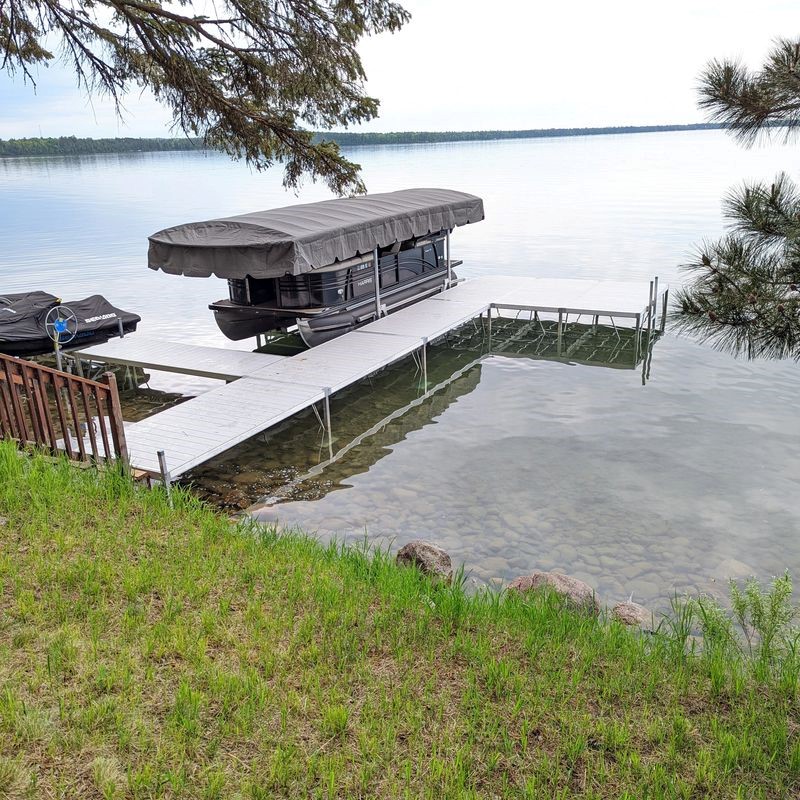
Buying a boat lift should make owning a boat easier. The right lift keeps your watercraft securely supported when it isn’t being used, provides convenient access to the lake, and helps protect an investment that may represent a significant part of your lakefront lifestyle.
But there is one specification you can’t afford to overlook: boat lift capacity.
Choosing the right boat lift capacity involves more than finding your boat’s advertised weight and purchasing a lift with a similar number on the label. Your boat’s actual loaded weight, equipment, batteries, fuel, accessories, hull configuration, and even future boating plans can influence the lift you need.
For Minnesota lake property owners, shoreline and water conditions add another layer to the decision. A properly sized boat lift needs to support your watercraft while also fitting the environment where it will be installed.
Understanding boat lift weight capacity before purchasing can help you make a more informed decision and avoid one of the most common mistakes in boat lift selection: choosing a lift without considering the complete weight and configuration it will actually support.
Boat lift capacity is the maximum weight a particular lift is designed to support under the manufacturer’s specifications.
For example, Sidco Docks offers Tidal hydraulic boat and pontoon lifts with capacities ranging from 4,000 to 8,000 pounds.
That doesn’t mean every boat weighing less than 8,000 pounds automatically belongs on an 8,000-pound lift, nor does it mean a boat with a published dry weight of 3,900 pounds is necessarily an appropriate match for a 4,000-pound lift.
Why?
Because dry weight isn’t necessarily the same as the weight sitting on your boat lift.
Understanding that difference is the first step toward choosing the correct boat lift capacity.
When researching a boat, you’ll commonly encounter a manufacturer’s listed dry weight.
Dry weight can be useful for comparing boats, but it should not automatically be treated as the final number for sizing a boat lift.
Depending on how a manufacturer defines its specifications, the published weight may not account for everything that eventually becomes part of your boat.
Your actual setup may include:
Individually, some of these items don’t seem particularly significant. Together, however, they can add meaningful weight.
The goal when choosing a boat lift isn’t to determine the lightest your boat could possibly be.
It’s to understand the realistic weight the lift will need to support.
The best place to begin is with accurate information about your watercraft.
Locate the manufacturer’s specifications for the exact:
Be careful about relying on numbers from online forums, marketplace listings, or specifications for a similar model.
Two boats that appear nearly identical can have different engines, layouts, equipment packages, or model-year specifications.
If you’re uncertain about what a published weight includes, consult the boat manufacturer or dealer rather than assuming.
Accurate boat lift sizing begins with accurate boat information.
Fuel is one of the easiest items to overlook.
A boat with a substantial fuel tank can carry significant additional weight when that tank is full. If you normally return to your lift with fuel in the boat, that weight matters.
Instead of sizing a lift around the boat’s lightest possible condition, consider how the boat is actually used.
Ask yourself:
If you’re unsure, confirm the manufacturer’s specifications.
The objective is to develop a realistic estimate of the boat’s loaded weight rather than relying on a best-case number.
Modern boats can carry multiple batteries.
Depending on the boat, those may power:
Battery weight is easy to forget because batteries are permanently tucked away and rarely thought about once installed.
But the boat lift still supports them every time it raises the boat.
Include installed batteries when determining the realistic weight your lift must handle.
The engine is another critical part of boat lift capacity planning.
Depending on the boat and the way its manufacturer reports weight, an outboard engine may need to be considered separately from the published hull or package weight.
Engine size can make a substantial difference.
This is another reason guessing based on boat length is unreliable.
Two boats of similar length can have significantly different total weights because of their construction, engines, equipment, and intended use.
Always size a lift using verified weight information rather than assumptions based solely on dimensions.
Lake life tends to accumulate equipment.
A boat that left the dealership in relatively simple form may later gain:
Some accessories stay on the boat all season.
Those items become part of the weight your boat lift supports.
If you’re adding significant equipment to an existing boat, it can be worth reevaluating whether the current lift remains appropriately sized.
Most lake homeowners don’t completely empty their boat every evening.
Life jackets stay aboard. Fishing tackle remains in storage compartments. Tow ropes, tools, anchors, water toys, and other equipment may remain onboard for much of the season.
A single item might not affect your boat lift decision.
The combined load is what matters.
When estimating the weight of your boat for lift sizing, think about what is normally aboard when the boat is stored, not simply what was included when it left the factory.
That gives you a much more useful figure for selecting boat lift capacity.
Weight capacity is essential, but choosing a boat lift shouldn’t stop there.
The lift also needs to physically accommodate the watercraft.
Important considerations can include:
Sidco Docks’ Tidal lifts offer customizable bunk and guide-in bumper options designed to accommodate most boats and pontoons. Matching those components to the watercraft is an important part of creating a properly fitted system.
A lift with adequate weight capacity but an inappropriate physical configuration still isn’t the right lift.
Boats don’t necessarily distribute their weight evenly from bow to stern.
Engines, batteries, fuel tanks, and equipment can concentrate significant weight in certain areas.
That is why proper positioning on the lift matters.
The boat should sit on the lift according to the manufacturer’s requirements, with bunks and other supporting components correctly configured for the hull.
Incorrect positioning can affect how loads are transferred through the lift.
Rather than assuming that adequate capacity solves every sizing issue, treat capacity and proper fit as two parts of the same decision.
Pontoon owners shouldn’t assume capacity selection is simpler.
Pontoons vary considerably in:
A larger pontoon with a substantial outboard and extensive equipment can weigh much more than someone might estimate from appearance alone.
Sidco Docks specifically offers Tidal lifts for both boats and pontoons, with multiple capacity options and customizable bunks and guide-in bumpers.
As with any watercraft, start with the manufacturer’s specifications and then consider the complete loaded configuration.
A common question is whether it’s worthwhile to choose a boat lift with capacity above the calculated weight of the current boat.
There are good reasons not to size a lift right at the edge of an uncertain weight estimate.
Your boat may carry more equipment in the future. You may install additional accessories. Your original weight estimate may also change once every component is accounted for.
However, that doesn’t mean the solution is simply to purchase the highest-capacity lift available.
The better approach is to establish the boat’s realistic loaded weight and then select a lift capacity that meets the lift manufacturer’s requirements for that watercraft and installation.
Proper sizing is more useful than arbitrary oversizing.
Lake homeowners frequently upgrade their boats.
Today’s fishing boat might eventually be replaced by a larger model. A family may move from a smaller pontoon to one with a larger engine and more amenities.
If you already expect to upgrade in the near future, discuss that possibility when choosing a lift.
Purchasing a lift solely for a boat you expect to replace soon could result in having to reconsider the lift as well.
You don’t need to predict every future purchase, but known plans are worth including in the conversation.
Boat lift capacity tells you how much weight the lift is designed to support.
It doesn’t tell you whether a particular installation is right for your shoreline.
Minnesota lake properties vary tremendously.
Important conditions include:
A lift needs to be appropriately sized for the boat and properly installed for the site.
For example, changing water depth can influence where the lift can be positioned and how easily the boat can enter and leave it.
A professional site assessment can help connect the specifications of the lift with the realities of the waterfront.
Capacity is only one part of everyday boat lift ownership.
Ease of operation matters too.
Sidco Docks’ Tidal hydraulic lifts place hydraulic components above the water and use a two-cable hydraulic design. Available controls include wired controllers, wireless remotes, and Bluetooth connectivity.
These features don’t change the fundamental requirement to choose the correct capacity, but they can influence how convenient the lift is to use throughout the boating season.
When comparing boat lifts, evaluate the complete system rather than looking at capacity in isolation.
A canopy can provide valuable protection from sun, rain, and debris.
If you plan to add one, include it in your initial lift planning rather than treating it as an afterthought.
Sidco Docks offers Tidal aluminum canopy frames in lengths from 20 to 32 feet, with multiple fabric options. The appropriate canopy depends on the watercraft and lift configuration.
Planning the lift, bunks, guides, and canopy together helps create a more cohesive setup.
Boat lift capacity isn’t a specification where guesswork makes sense.
If the boat’s realistic loaded weight appears close to the lift’s maximum capacity, don’t simply assume it will be fine.
Verify the numbers.
Recheck:
Then discuss the resulting configuration with a knowledgeable lift provider and follow the lift manufacturer’s requirements.
A few extra minutes spent verifying specifications can prevent a much larger problem later.
If you’re replacing your boat but keeping an existing lift, capacity should be reevaluated.
Don’t assume the new boat will work because it has roughly the same length as the old one.
Compare the new watercraft’s:
You should also inspect the existing lift’s condition.
Age, cables, hardware, bunks, structural condition, and other components may matter before putting a different watercraft on it.
If the lift’s original capacity information is missing or unclear, identify the model and verify its specifications rather than estimating.
A used boat lift can look like a good match based on size alone, but capacity and compatibility need to be confirmed before installation.
Look for manufacturer and model information and verify:
Minnesota owners should also remember aquatic invasive species requirements when moving used waterfront equipment between lakes.
Minnesota DNR guidance requires docks, lifts, and rafts removed from one waterbody to remain out of the water for at least 21 days before being placed into another waterbody. Equipment should also be inspected and cleaned of aquatic plants and prohibited invasive species.
That makes planning particularly important when purchasing a used boat lift from another lake.
Even a correctly sized boat lift needs proper installation.
Installation affects:
Sidco Docks provides boat lift sales along with professional installation, seasonal removal, and repair services for Minnesota lakefront property owners.
The company also operates two barges equipped with hydraulic lifts for waterfront work, allowing equipment to be transported and positioned on the water.
For homeowners in the Brainerd Lakes area, having lift selection and installation considered together can help ensure the equipment matches both the boat and the shoreline.
Before selecting a boat lift, gather the following information:
Boat information
Power and equipment
Typical onboard load
Waterfront information
Future plans
Having this information available makes it much easier to compare boat lift options accurately.
The goal of boat lift sizing isn’t to find the smallest lift that might technically work.
It’s to select equipment appropriately matched to the actual watercraft, its normal loaded condition, and the waterfront where the lift will operate.
Start with verified manufacturer specifications. Account for fuel, batteries, equipment, and accessories. Consider the boat’s physical dimensions and hull configuration. Then match those requirements to a lift that is appropriately rated and configured.
For Sidco Docks customers, Tidal hydraulic boat and pontoon lifts are currently available in capacities ranging from 4,000 to 8,000 pounds, providing several options for different watercraft.
A correctly selected boat lift can make everyday lake life simpler while giving your watercraft dependable support season after season.
Sidco Docks is based in Pillager, Minnesota, serving lakefront property owners in the Brainerd Lakes area with dock and boat lift sales, professional installation, seasonal removal, repairs, barge services, and storm recovery.
For questions about boat lift capacity, Tidal boat and pontoon lifts, or fitting a lift to a specific watercraft:
Sidco Docks
Location: Pillager, Minnesota
Phone: (218) 838-7179
Email: yourdockguy@hotmail.com